Lady Louisa of Traquair was the 15th and last of the Lairds of Traquair. She had remained unmarried for all her long life and when she died at the age of 99 the estate went to the female line of the family, the Maxwell Stuarts. Her predecessor, the 14th Laird of Traquair had no head... Continue Reading →
tailor, major, and prisoner
Blackmount is a pretty and small graveyard on the border between Peeblesshire and Lanarkshire. The cemetery goes back to the late 18th century. Many stones are very old and somewhere in between these stones a man was buried who left no gravestone to remember him. He was a tailor, a major and a prisoner. ... Continue Reading →
Peebles and Santa Claus
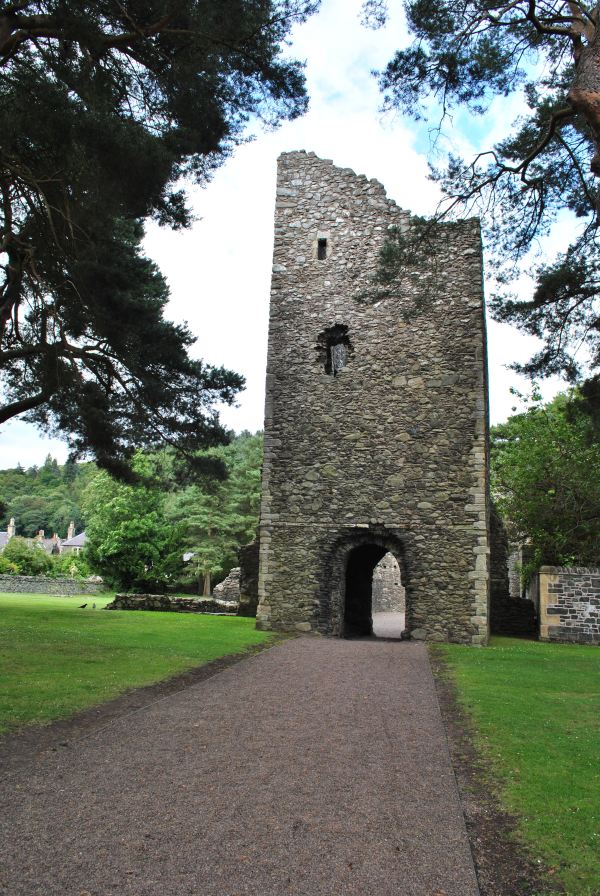
The Cross Kirk played an important role for the people of Peebles in the past. Not anymore. The ruin suggests a massive and castle-like construction, an atmosphere of war rather than prayer seems to surround it. This was once a monastery, one of many that flourished in Scotland’s South in the Middle Ages and then... Continue Reading →
names and nemesis
Yarrow kirkyard Names locate people, especially in Scotland. Many of the big names are names from the Highlands, like MacDonald. In the south of Scotland, the picture looks different, other surnames established: Armstrong, Scott, Maxwell, for example. All over Scotland nicknames were given generously and just like in the Highlands, each Border clan has a... Continue Reading →
Dalserf hogback stone
Upper Clydesdale is geographically determined by the River Clyde, the longest river in the United Kingdom. It has contributed much to the industrialization of the region; the model city of New Lanark personifies that like no other. But away from the industrial centres, Lanarkshire is quiet and pretty. There is something to discover everywhere. Dalserf... Continue Reading →
Bruce’s dead heir
Restenneth’s impressive tower adds grandeur to the modest simplicity of the structure that albeit many additons still feels very much 12th century. It is certainly one of the oldest churches in Scotland. The Picts Angus is the heart of the land of the Picts. If you know where to look, you’ll find their traces everywhere.... Continue Reading →
the mutineers‘ end
Tolsta marks the end of an unhappy journey. Francois Gautiez an French cook and the English mate Peter Heaman were on board of the ship Jane, commanded by Thomas Johnson. The Jane of Gibraltar was heading for Bahia de Brazil and among the many things she was carrying were also Spanish silver Dollars, a considerable... Continue Reading →
death on the beach
Luskentyre (Losgaintir in Gaelic) is probably the most famous beach in the whole of the Western Isles; it certainly is one of the most spectacular ones with a haunting beauty, endless white sand and sparkling emerald water. What a place to bury the dead! Burying near a beach is standard practice on the Island of... Continue Reading →
from Sea God to Saint
Barvas cemetery Cladh Mhuire, Isle of Lewis Lewis differs in so many things from the rest of Scotland but the most obvious to visitors is faith. Religion plays a very prominent role on the island and the church certainly has more influence on life and death than anywhere else in Scotland. Even the smallest of... Continue Reading →
an axe wound, mass murder and lust
St Clement’s church, Rodel, Isle of Harris St Clement’s was built as a catholic church under David I, probably by one of the MacLeods of Harris but falling into disuse soon after completion. The Reformation had put an end to Catholicism on the island. It had most likely been a priory, two allegedly excisted on... Continue Reading →


Recent Comments