a partisan for the pretender When Charles Edward Stuart came to Scotland in 1745 to conquer his crown and his realm, the young king-to-be landed in the Western Highlands, where he could count on most supporters. There were not many in the Borders who would have given him unwavering support, with one big exception: James... Continue Reading →
shoon and sheets – the Sutor of Selkirk
A cobbler's profession is generally not a particularly exciting or scary one. A shoemaker in the early 19th century had an upscale clientel and was a respected citizen. The cobbler of Selkirk (Sutor of Selkirk) brought it to a certain fame but not because of his shoes but his greed and his nosiness. He was... Continue Reading →
harsh words
epitaph for a suicide Here lies in earth a root of Hell, Set by the Diel's ain bible; This worthless body damn'd himself, To save the Lord the trouble. Raymont Lamont-Brown: Scottish Epitaphs. Chambers, Edinburgh, 1990
preserving paradise
Lyne Kirkyard The graveyards of the Borders are well documented and in Lyne special effort for conservation have been made. The old gravestone with the beautiful Adam and Eve carving was cleaned and treated against moss and lichen and put under perspex for protection. Paradise protected but lost. Perspex and treatment help preserving the stone... Continue Reading →
graveyard excorcism
Two ghosts are said to haunt the ruined Sanquhar Castle. A third one appeared in Sanquhar graveyard on the other side of town. He seems to have been the creepiest of them all. His name was Abraham Crichton. Crichton was a wealthy gentleman, a laird with extensive lands in the area. Nevertheless, he went bankrupt... Continue Reading →
Scottish epitaphs: Gordon Fraser from Wigtown
O bury me at Wigtown, And o'er me raise a modest stane, Tae tell the folks when I am gane, The cauld mools wrap the banes o' ane Wha wrote and sang o' Wigtown. Scottish words: mools = earth, cauld = cold, banes = bones Raymont Lamont-Brown: Scottish Epitaphs. Chambers, Edinburgh, 1990
ghost of a spinster
Lady Louisa of Traquair was the 15th and last of the Lairds of Traquair. She had remained unmarried for all her long life and when she died at the age of 99 the estate went to the female line of the family, the Maxwell Stuarts. Her predecessor, the 14th Laird of Traquair had no head... Continue Reading →
tailor, major, and prisoner
Blackmount is a pretty and small graveyard on the border between Peeblesshire and Lanarkshire. The cemetery goes back to the late 18th century. Many stones are very old and somewhere in between these stones a man was buried who left no gravestone to remember him. He was a tailor, a major and a prisoner. ... Continue Reading →
skull and crossbones
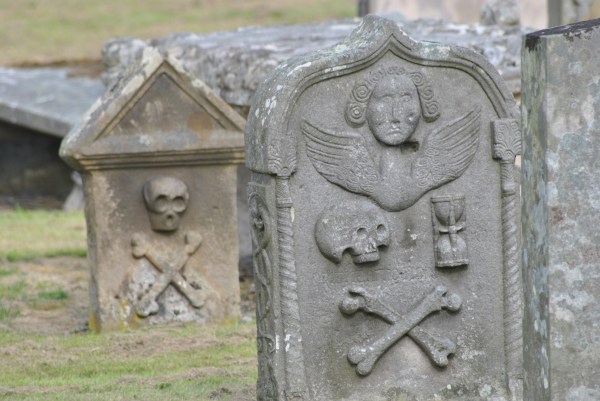
The skull and crossbones are probably the oldest mortality symbols found on Scottish graveyards. The old cemetery in Peebles has a large collection of old stones decorated with a skull or a skull and crossbones. Often an hour glass is combined to signify time running out, or a winged death's head also indicating that life... Continue Reading →
Funny Scottish Epitaphs – the Sorbie Soldier
Here lies removed from mundane scenes, A major of the King's Marines, Under arrest in narrow borders He rises not till further orders. Raymont Lamont-Brown: Scottish Epitaphs. Chambers, Edinburgh, 1990


Recent Comments